


Conversational AI is the most misunderstood term in enterprise software right now. In customer service it means a chatbot. In coaching it means something completely different, a structured practice loop where a rep speaks with a virtual buyer or customer, the AI listens, scores the behavior, and feeds the next practice back. This guide is about the coaching version, why it works, and where it does not.
Conversational AI for coaching is software that runs a real-time dialogue with a person (a sales rep, a service agent, a manager), interprets what they say and how they say it, and produces measurable behavioral feedback. It is the engine behind AI roleplay practice, behavioral scoring, and the dashboards that show a manager which behaviors are improving and which need targeted reinforcement.
It is not the same as a chatbot. A chatbot resolves a customer question with a scripted response. Conversational AI for coaching does the opposite, it pushes back, asks harder follow-ups, and looks for specific named behaviors the practitioner is trying to build. The two technologies share some underlying NLP, but the product, the deployment, and the value created are different.
For L&D, sales enablement, and customer service capability teams, the right question is not "should we use conversational AI?" but "where in our coaching loop does it actually move outcomes?" The answer is consistent: practice volume, behavioral fidelity, and feedback latency. We will walk through each.
Where Conversational AI Actually Creates Value
The marketing pitch for conversational AI is broad enough to mean nothing. The honest breakdown, where it moves real outcomes inside an enterprise coaching program, is narrower. Here is the value split, based on what production deployments consistently report:
How Behavioral Skill Compounds Across Practice Sessions
The biggest misconception about conversational AI coaching is that the value lands in week one. It does not. Week one is acquisition cost, the rep is learning how the platform works. The real payoff comes from compounding 2% behavioral improvement per session over 8-12 weeks. Here is what the curve typically looks like:
Conversational AI Use Cases by Impact and Effort
Not every conversational AI use case is worth the budget. The cleanest way to prioritize is to plot each candidate on two axes: how much it moves the metric you care about, and how much enablement effort it takes to deploy. The bubble size represents typical rollout time. Here is how the common candidates land:
Conversational AI is not a feature you bolt on. It is a category of software that does one thing well, run a structured dialogue at scale and score behavior in real time. Pick one use case where that capability moves a metric you can defend. Skip the rest until you have proof.
Retorio capability team, recurring observation across enterprise coaching deploymentsConversational AI for Coaching vs Customer Service Chatbots
The two get conflated because they share a NLP backbone. They are doing opposite jobs, optimizing for opposite outcomes. Here is the side-by-side that matters when an L&D or enablement leader is evaluating a vendor:
Conversational AI Coaching vs Traditional Training Across 5 Dimensions
Plotted against the levers L&D leaders actually care about, the gap is not subtle. Each dimension below scores out of 100 for both approaches:
How a Conversational AI Coaching Session Works (Step by Step)
The mechanic is simple. The discipline that separates a coaching system from a roleplay novelty is in the loop closure. Every session does five things in roughly 10 minutes:
The rep sees the brief: who they are talking to, what the goal is, what behavior is being scored. Example: "You are calling a CFO who is six weeks into evaluating your platform. Goal: anchor the discussion on quantified business outcomes before discussing pricing. Scored behavior: question density before any product mention."
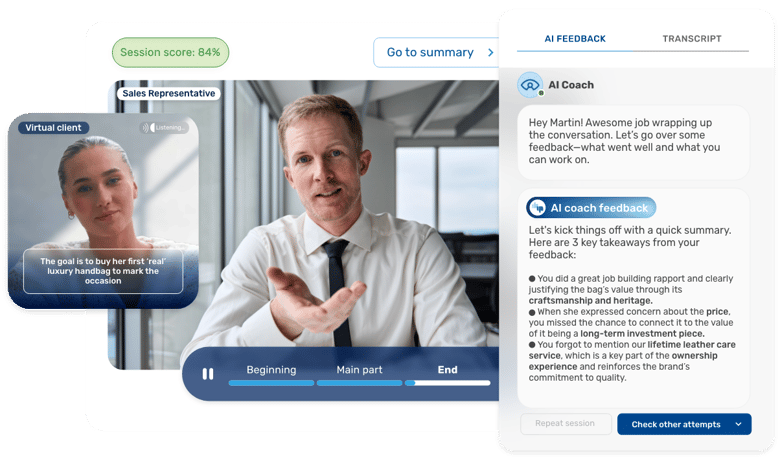
The virtual buyer opens the conversation. The rep responds in real-time voice. The AI listens, parses intent, scores tone and pacing, and decides what to say next. The pushback is calibrated, not scripted. If the rep frames the value well, the AI escalates. If the rep stumbles, the AI escalates differently.
The scenario does not let the rep cruise past the target behavior. If the goal is to anchor on outcomes before pricing, the AI will redirect to pricing repeatedly until the rep practices the redirect successfully or runs out of attempts. This is where compounding practice actually happens.
The session wraps. Within seconds, the rep sees: score against the named behavior (0-100), specific transcript moments where the behavior landed or missed, comparison to top-quartile peers, and the next scenario queued for them based on the gap.
The team dashboard shows the manager which behaviors are improving across the team, which reps need attention, and which scenarios are producing the biggest behavior shifts. Manager spends 15 minutes per rep per week, reviewing patterns instead of recordings.

See conversational AI coaching in action
A 30-minute walkthrough shows how Retorio runs behavioral coaching scenarios for a sales or service team, calibrated to your role, product, and buyer shape. Start with one scenario, one team, one cycle.
Start with RetorioFAQ: Conversational AI for Coaching
What is conversational AI in the context of enterprise coaching?
Conversational AI for coaching is software that runs a real-time spoken dialogue with a person (rep, agent, or manager), interprets what they say and how they say it, and produces measurable behavioral feedback within seconds. The use cases include sales discovery practice, customer service escalation training, MLR-aware pharma detailing, and leadership conversation rehearsal. It differs from a customer service chatbot, which optimizes for fast resolution rather than behavior building.
How is conversational AI different from a chatbot?
A chatbot is cooperative, it tries to resolve the customer's question as fast as possible. Coaching conversational AI is adversarial by design, it pushes back, asks harder follow-ups, and looks for specific named behaviors the rep is trying to build. Same underlying NLP, opposite job to be done, different vendor categories.
Does conversational AI replace the manager or the trainer?
No, it shifts what they do. The manager moves from spending 30-90 minutes per rep per week on call reviews to spending 15 minutes per rep per week reviewing a behavioral dashboard. The trainer moves from designing one annual workshop to maintaining a scenario library that updates as the market changes. Both roles become more strategic, not redundant.
How long until conversational AI coaching shows measurable results?
Early behavioral signal in 2-3 weeks, behavior carrying into recorded calls at 6-12 weeks, conversion lift in the pipeline at 60-90 days. Across enterprise deployments, teams see roughly 2% behavioral improvement per AI-assisted session, compounding to measurable conversion change by month three.
Is conversational AI compliant with EU AI Act and GDPR for enterprise deployments?
For coaching use cases (internal practice, no real customer exposure), the regulatory load is comparatively low. Retorio specifically is GDPR/DSGVO compliant, ISO 27001 certified, EU AI Act aligned, and hosted on GCP with EU data residency. Customer service chatbot vendors carry a heavier compliance load because they talk to real customers, that is a different risk profile.