


"Be more empathetic" is not a coachable behavior. "Name the customer's impact before offering a fix" is. This is the difference between soft-skills theater and soft-skills training that moves CSAT, NPS, and escalation reduction. Here are 10 customer service soft skills, each with what to say, what NOT to say, and how to measure the behavior on a recorded call.
The 10 customer service soft skills that consistently move metrics are: (1) active listening, (2) empathy framed as impact-naming, (3) patience under repetition, (4) tone calibration when the customer escalates, (5) clarity in explanation, (6) ownership of the resolution, (7) de-escalation timing, (8) product knowledge translated into customer language, (9) a forwardable summary at close, and (10) emotional self-regulation under load.
Each is observable on a recorded call. Each is coachable in 2-3 weeks. Each has a script the agent can practice and a counter-script they should avoid. The post below has all 10 with specific dialogue examples.
The 10 Customer Service Soft Skills That Move Metrics
Each skill below has three parts. The named behavior. The scripted "do this" example. The "do not say this" counter-script that most agents default to. Practice the named behavior, not the abstract trait.
Behavior: let the customer finish a full thought before responding. Count interruptions per minute. Say: "Take me through what happened, from the beginning." Do not say: "I get it, I get it, here's what you should do." (Interrupting with empathy is still interrupting.)
Behavior: before offering a fix, name the specific impact the customer experienced. Say: "This outage hit you on Monday morning when you were already running short on people. That's a hard combination." Do not say: "I understand your frustration, let me transfer you to billing." (Generic empathy + protocol = the customer hangs up.)
Behavior: when the customer asks the same question a third time, answer as if it were the first. Tone matters more than words. Say: "Sure, the timeline for resolution is 48 hours, here is what we are doing in that window." Do not say: "As I mentioned earlier..." (The customer heard it. They didn't believe it. The repeat is the test.)
Behavior: when the customer's pace quickens, slow down. Do not match the energy. Say (slower, lower): "I hear you. Let me make sure I have this right before I do anything else." Do not say (fast, defensive): "If you let me explain... if you let me explain..." (Matching escalation escalates.)
Behavior: translate every internal term into customer language. Say: "Your account is in what we call a hold state, which means orders pause until we clear the payment issue. Here is what clears it." Do not say: "Your CSC flag is active so the OMS is queuing." (The customer does not work at your company. They cannot decode your team's TLAs.)
Behavior: use "I" not "we" when committing to action. Use "we" when describing the company position. Say: "I am going to call billing right now and stay on the line until this is sorted. I will text you the resolution number before we hang up." Do not say: "We will look into it." (Diffuse responsibility tells the customer nothing will happen.)
Behavior: when the customer is spiraling on the same complaint, name the pattern and pivot. Say: "I am hearing the same concern come up three times. Let me try to solve it now rather than keep apologizing for it." Do not say: "Sir, please calm down." (Telling a customer to calm down has a 0% success rate.)
Behavior: know the product, but never lead with the product. Lead with the customer's job. Say: "For your use case (running payroll for 200 people), the feature you want is in the report builder. It is not enabled by default. I am turning it on now." Do not say: "Have you considered upgrading your plan?" (Cross-sell during a service call kills trust.)
Behavior: never end a call without sending the customer something they can forward. Say: "I am sending you a one-paragraph summary now: what happened, what we did, when you should expect resolution, my direct contact if it does not land. You can forward it to your team." Do not say: "I will follow up." (No one knows what "follow up" means. The customer cannot use it.)
Behavior: when the 17th caller of the day is also escalated, the agent's tone in call 17 should match their tone in call 1. Say (same as call 1): "Tell me what happened." Do not say (call 17 fatigue): "Mhm... yeah... so what happened was..." (Fatigue tone broadcasts that the agent has stopped listening. Customers detect it instantly.)
The 5 Skill Categories These 10 Behaviors Map To
The 10 behaviors above cluster into 5 measurable skill categories. Each category gets one coaching cycle (2 weeks). After 10 weeks, the agent has practiced all five categories with measurable behavior change on recorded calls:
Which Skill Matters Most in Which Scenario
The 10 skills do not weight equally across every customer interaction. The quadrant below maps the 5 categories against scenario type (calm vs escalated) and customer goal (resolution vs reassurance):
Most customer service "soft-skills" training is a list of personality traits with a quiz. The training that moves CSAT is a named behavior with a script, practiced weekly against a virtual customer, scored on real recordings. The list is the same. The mechanic is different.
Retorio capability team, recurring observation across enterprise service deploymentsTraditional Customer Service Training vs Behavioral Coaching
The gap between "soft-skills workshop" and behavioral coaching is wide. Scored against the dimensions that matter for a service org:
"Do This" vs "Don't Say That": Side-by-Side Reference
Print this. Tape it next to the headset. Most agents already know the wrong thing not to say, the value is in keeping the right script visible during the 17th call of the day.
Run the 10-week soft-skills cycle with Retorio
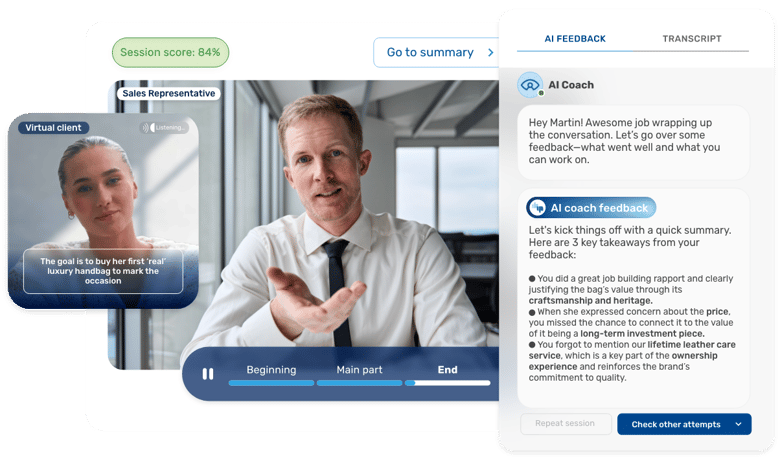
Retorio scores every named customer service behavior automatically on AI scenarios and on recorded calls if you connect them. The agent gets immediate feedback, the manager gets a dashboard, the org gets behavior change in 90 days.
Start with RetorioFAQ: Customer Service Soft Skills
What are the most important soft skills for customer service?
The 10 that consistently move CSAT and NPS: active listening, empathy framed as impact-naming, patience under repetition, tone calibration when the customer escalates, clarity in explanation (no jargon), ownership of the resolution, de-escalation timing, product knowledge translated into customer impact, forwardable summary at close, and emotional self-regulation under load. Each is observable on a recorded call and coachable in 2-3 weeks.
How do you train soft skills for customer service agents?
Not with a workshop. The format that consistently moves the metric is one named behavior per week, practiced in scenario with a virtual customer, scored against the named behavior, debriefed by the manager via dashboard. The 10 underlying skills cluster into 5 categories; 2 weeks per category = 10-week rollout.
How do you measure soft skills on a customer service call?
By counting specific markers on recorded calls: interruptions per minute (listening), paraphrase moments per customer concern (reflection), impact-naming statements per escalation (empathy), tone calibration moments (slow-down on customer escalation), and outbound forwardable artifacts per closed call. AI platforms like Retorio automate this scoring; manual call-listening works at small scale but breaks past 8 agents per manager.
What is the difference between empathy and impact-naming?
"I understand your frustration" is empathy as a phrase. The customer hears it 100 times a week and tunes it out. "This outage hit you on Monday morning when you were already short-staffed, that is a hard combination" is empathy as a specific impact statement. The customer feels heard because the agent demonstrated they understood the specific situation, not the generic emotion. Empathy framed as impact-naming is the coachable, measurable version.
Can soft skills be coached remotely?
Yes. The mechanic is AI-driven scenario practice (which is remote-by-design) plus manager dashboard oversight. Most production deployments are fully remote. The behaviors that move metrics are no different between in-office and distributed teams, the mechanism that delivers the coaching changes, the curriculum does not.