


There are 50+ companies pitching tech enterprise sales training in 2026. None of them will tell you they are the wrong fit. This post does. It compares 10 named programs on the dimensions that decide whether your reps actually close more deals, format, fit, price, and where each program falls short. Including ours.
The top 10 tech enterprise sales training programs in 2026, ranked by fit for complex multi-stakeholder enterprise software deals: (1) Retorio, AI behavioral coaching at scale, (2) Force Management, the MEDDPICC enterprise playbook, (3) Winning by Design, the Bowtie revenue framework for SaaS, (4) Richardson Sales Performance, legacy enterprise methodology, (5) JBarrows Sales Training, pipeline and SDR depth, (6) Pavilion, community plus courses for revenue leaders, (7) Sandler Training, the methodology classic, (8) pclub.io, cohort-based AE program, (9) Sales Assembly, community plus role-based curricula, (10) Coursera Fundamentals of Technology Sales, self-paced entry.
No single program is best for every team. The right pick depends on team size, deal complexity, what you measure, and whether you need a classroom event or a behavioral coaching loop that runs every week. The comparison matrix below makes the trade-offs explicit.
Selection Criteria: What to Look for in a Top-Tier Program
Before you read the list, here are the five dimensions to score every vendor on. Get these right and the comparison is straightforward. Skip them and you will end up choosing on brand familiarity.
The 10 Best Tech Sales Training Programs in 2026
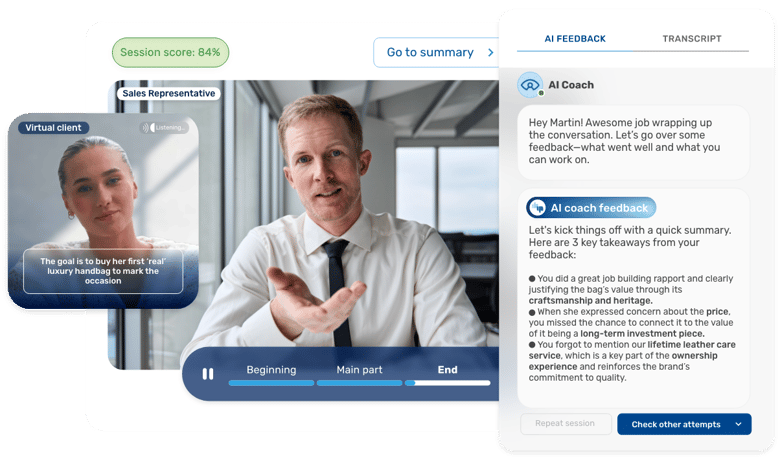
Format: AI-driven scenario practice with a virtual buyer, behavioral scoring across 140+ signals, manager dashboard. Best for: AE, CSM, and customer service teams above 40 reps where manager bandwidth is the constraint. Price signal: $$. Differentiator: the loop closes, every scenario is scored against named behaviors and the next practice queues automatically. Manager spends 15 minutes per rep per week on dashboards, not call reviews. Used across 80+ enterprise customers and 4,609 reps. Where it falls short: not a methodology vendor, you pair it with your existing framework (MEDDPICC, BANT, or your own) rather than buying one.
Format: Methodology workshops, deal qualification framework, manager coaching playbooks. Best for: enterprise AE teams selling $100K+ deals with multi-stakeholder buying committees. Price signal: $$$. Differentiator: MEDDPICC is the dominant qualification framework in enterprise tech, and Force Management owns the institutional knowledge. Their command-of-the-message approach gives reps a structured way to talk about value. Where it falls short: classroom-led, requires manager bandwidth to reinforce weekly. Scales economically up to a couple hundred reps but the marginal cost stays high.
Format: Methodology-led cohort programs, video courses, advisory engagements. Best for: SaaS sales teams that want a recurring-revenue mental model and a clear handoff between marketing, sales, CS, and renewals. Price signal: $$ to $$$. Differentiator: Jacco van der Kooij's Bowtie framework is the cleanest model for SaaS revenue motion, and the materials are well-produced. Strong with growth-stage SaaS. Where it falls short: the methodology is excellent on paper but reinforcement still depends on whether your managers run the rhythm. No built-in behavioral scoring.
Format: Custom methodology programs, sprint workshops, manager coaching certification, blended digital and live. Best for: Fortune 500 tech enterprise with 500+ reps and existing methodology investments. Price signal: $$$. Differentiator: decades of enterprise tech specialization, deep customization capability, strong manager coaching tracks. Trusted by IBM, Cisco, large telecom and infra companies. Where it falls short: heavy enterprise procurement timeline, premium pricing, and the "blended digital" component is improving but still trails AI-native vendors on practice volume per rep.
Format: Cohort programs, self-paced courses, manager coaching, community access. Best for: SDR and early-stage AE teams focused on pipeline generation, prospecting, and cold-outbound skills. Price signal: $ to $$. Differentiator: John Barrows is the most credible name in the SDR space, the content is practical, and the community is engaged. Especially strong on email and call openers. Where it falls short: not built for complex enterprise AE work or multi-stakeholder champion enablement. Stops being differentiated once your reps are working $100K+ deals.
Format: Membership community, certifications (CRO School, VP Sales School, Sales School), peer benchmarking. Best for: revenue leaders, VPs, and senior AEs who learn best by talking to peers. Strong for the strategic side of the role. Price signal: $$. Differentiator: the community is the product, peer benchmarking on compensation, headcount, and process is genuinely useful. Certifications are credible. Where it falls short: not a behavioral coaching program for frontline reps. Limited rep-level skill transfer, this is leadership development.
Format: Classroom workshops, virtual cohorts, certified franchisee network, online curriculum. Best for: mid-market and enterprise teams that want a single methodology installed across the org. Price signal: $$. Differentiator: the Sandler methodology has been around since 1967, and the franchisee network gives local delivery options globally. Reliable mid-market choice. Where it falls short: the underlying methodology is showing its age, less calibrated to multi-stakeholder enterprise SaaS than Force Management or Winning by Design. Quality varies by franchisee.
Format: Live cohort programs, paid certifications, content library. Best for: mid-career AEs who want a structured upskilling cohort outside their employer. Price signal: $ to $$. Differentiator: newer entrant with a strong community angle and SERP visibility. Curriculum is calibrated to modern tech sales (PLG-aware, modern outbound, AI-augmented workflow). Where it falls short: built for individual upskilling more than enterprise rollout. If you are evaluating for a 100-rep org, the deployment model is harder to scale than dedicated enterprise vendors.
Format: Membership community, role-based certification tracks (SDR, AE, CSM, manager), peer learning. Best for: SaaS revenue orgs that want both community-driven learning and structured certifications across roles. Price signal: $$. Differentiator: tight SaaS focus, vendor-neutral peer community, strong sub-tracks per role. Works well for distributed teams. Where it falls short: not a coaching loop, transfer to live calls still depends on your managers running internal reinforcement.
Format: Self-paced online course (~20-30 hours), certificate of completion. Best for: career-switchers, people learning tech sales fundamentals, or as a foundation layer before joining an enterprise team. Price signal: $. Differentiator: Coursera's brand and academic backing, accessible price, good fundamentals. Where it falls short: not enterprise-ready training, no behavioral coaching, no transfer-to-live-deals mechanism. Treat it as background reading, not as a team enablement solution.
The 5 Format Categories These 10 Programs Belong To
Rather than score every vendor on dimensions where we cannot publicly defend the number, here is the simpler honest view: each program belongs to one of five format categories, and the right category depends on your team's bandwidth, role mix, and deal complexity. Each vendor is mapped to its own self-declared format (verifiable on their marketing pages).
The right training program is not the one with the most polished sales deck. It is the one that fits the format your managers can actually reinforce week after week, on the role your reps actually play, against a measurement you can defend to your CRO.
Retorio capability team, recurring observation across enterprise tech deploymentsSide-by-Side Comparison: What Each Program Is For
One row per program, showing the cleanest summary of fit, format, price band, and the single sentence that separates one program from the next.
How to Evaluate Any Program for Your Team
Three questions cut through the vendor pitches faster than a feature comparison. Ask all three before the demo, and the right program will surface in 15 minutes.
The product demo will look great. Skip past that. Ask: 8 weeks after rollout, what is different about how a rep handles a real call versus today? Specifically. If the vendor cannot describe the behavioral change in concrete terms, the program will not move your numbers.
Every program is great in the pilot. The question is what shows up in the quarterly business review. Ask for a screenshot of the actual dashboard a current customer is using. If there is no dashboard, or the dashboard is a CSAT survey, the program is not built for revenue impact.
Every program scales beautifully up to some N reps. Past N, something breaks (manager bandwidth, content freshness, completion rates, cost per rep). Ask the vendor to tell you where the break point is in their own deployments. Vendors who cannot answer this either do not know or are hiding it.

Compare these programs against your team shape
A 30-minute walkthrough with the Retorio team maps the 10 programs against your specific team size, role mix, and revenue target. If we are not the right fit, we will say so and point to who is.
Start with RetorioFAQ: Tech Sales Training Programs in 2026
What is the best sales training program for tech enterprise companies in 2026?
There is no single best program. For teams above 40 reps that need scale and behavioral measurement, AI behavioral coaching (Retorio) fits best. For complex multi-stakeholder enterprise AE work, MEDDPICC-based methodology (Force Management). For SaaS revenue motion, Winning by Design. For SDR pipeline depth, JBarrows. The right answer depends on team size, deal complexity, and what you can reinforce weekly.
How is AI sales coaching different from traditional methodology training?
Methodology training (Force Management, Winning by Design, Sandler) installs a framework, MEDDPICC, BANT, Bowtie, into how reps think. AI coaching (Retorio) installs the behaviors, question density, tone calibration, champion enablement, that make any framework work in front of a real buyer. The two are complementary, not substitutes. Most enterprise teams need both: a framework + a coaching loop that builds the behaviors the framework requires.
How much should a tech enterprise sales training program cost in 2026?
Price bands vary widely. Self-paced online (Coursera) starts at $50-200 per learner. Community + cohort (JBarrows, pclub.io, Sales Assembly) typically lands $500-5,000 per learner per year. Methodology workshops (Force Management, Winning by Design, Richardson) often run $25K-150K+ per engagement plus license fees. AI behavioral coaching (Retorio) typically prices per seat per year, scaling down per-rep as headcount grows. ROI math matters more than ticket price, calculate cost per coached behavior change, not cost per certificate issued.
How long does it take to see results from a tech sales training program?
Early behavior shift appears at 2-3 weeks with weekly practice. Behavior carrying into recorded calls at 6-12 weeks. Measurable pipeline conversion lift at 60-90 days. Programs that promise faster than this are selling a workshop high, not behavior change. Programs that take longer than 90 days to show signal usually have a reinforcement gap (no weekly mechanism).
Can we combine multiple training programs?
Yes, and most mature enterprise teams do. Common combination: a methodology vendor (Force Management or Winning by Design) installs the framework + a behavioral coaching platform (Retorio) installs the practice loop + Pavilion or Sales Assembly community for revenue leadership development. The three layers do different jobs and stack well. The trap is buying two methodology vendors at once, that is when conflicting frameworks confuse the field.