


Technology enterprise AEs are not coached because their managers run out of time. A senior rep on a six-figure deal needs a 20-minute call review, and a frontline manager has 12 reps. AI coaching closes that math gap. Done right, it lifts win rates and ramps new hires faster, without adding a single hour to your enablement team.
AI sales coaching for technology enterprise companies is the practice of running structured behavioral coaching at scale, every rep, every week, using AI to observe call simulations, score specific behaviors, and feed the next practice back to the rep. It is not a roleplay tool. The roleplay is the input. The coaching is the loop that converts practice into measurable behavior change on real deals.
For SaaS, infrastructure, and platform companies, the highest revenue correlation behaviors are discovery questioning with a technical buyer, champion enablement (giving the champion something to forward), and value reframing during a stalled procurement cycle. All three are coachable through repeated scenario practice with behavioral feedback.
Teams that move from manager-led coaching to AI-assisted coaching see a measurable lift in win rate and a sharp drop in time-to-first-deal for new hires. The economics work because AI does not run out of bandwidth at the 13th rep.
Why Technology Enterprise Sales Is Uniquely Hard to Coach
A technology enterprise rep is closing a 14-month deal with a buying committee of seven people, two of whom they have never met. The product has 40 integration points. The competitor is incumbent. The CFO has just frozen new vendor spend. The manager has not listened to a single recording from this deal because they are running QBRs in three regions.
This is the coaching reality. Compared to transactional SaaS or SMB sales, tech enterprise has four properties that make traditional coaching break:
How AI Sales Coaching Works in a Tech Enterprise Setting
The mechanic is simple. The implementation discipline is what separates a coaching system that lifts numbers from a roleplay product that becomes shelfware in six months.
Every coaching cycle does three things, repeated weekly across the entire team:
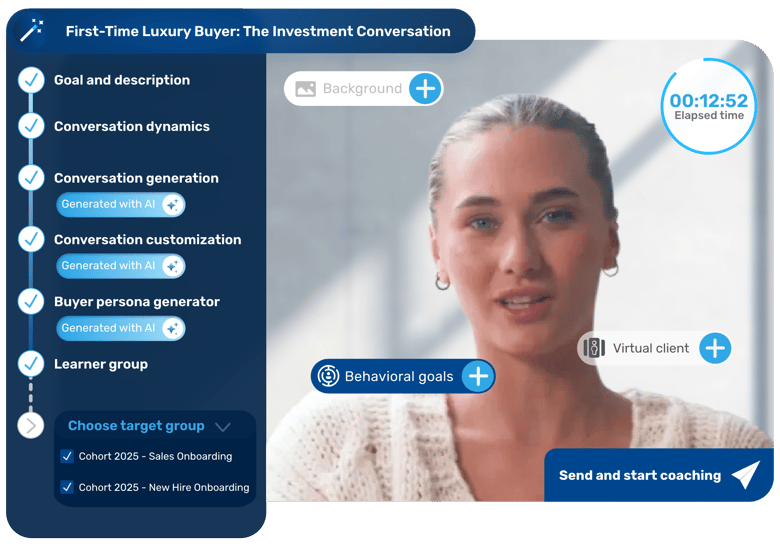
Coaching does not work on generic feedback ("be more consultative"). It works on a named, observable behavior: "anchor the discovery question on a quantified business outcome before raising any product feature." That is the unit. Every scenario is built around one. AI scores whether the named behavior appeared on the call.
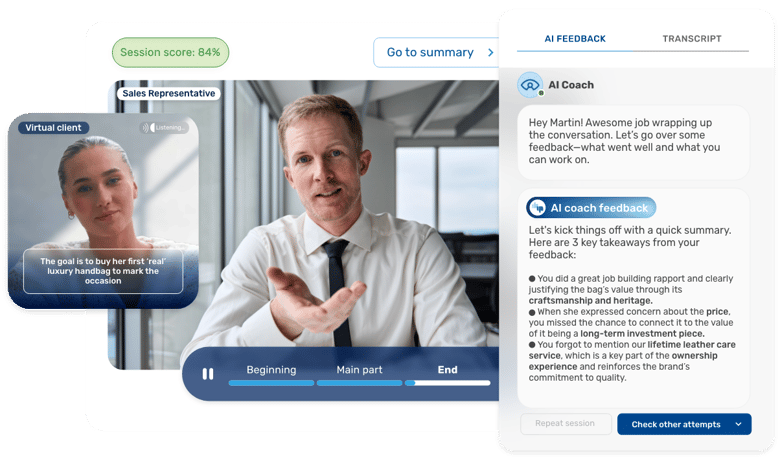
The rep runs the scenario with a virtual buyer. The buyer pushes back. The rep adapts. The session is 10 to 15 minutes, can be repeated three times in a sitting, and produces no risk to a live deal. This is where compounding behavior change happens, not in the call review of a deal that already went sideways.
AI scores tone, question density, response latency, technical depth, and roughly 135 other behavioral signals. The named behavior gets a 0-100 score. If the rep is below threshold, the next session targets the same behavior with a harder scenario. If above, the loop moves to the next behavior on the development plan. Managers see the dashboard, not every call.
Coached behavior transfers to real calls within 6 to 12 weeks of consistent practice. The rep starts to recognize when the buyer is escalating, when a CFO objection is real versus rehearsed, when a champion needs ammunition. Managers stop chasing call recordings and start running team-level pattern conversations: "the deals stuck at procurement all share this missing behavior."
The difference between AI coaching that lifts numbers and AI coaching that ends up in the graveyard of unused enablement tools is specificity. If the behavior you are coaching cannot be observed and counted on a call, it is not a coaching target. It is a personality wish.
Retorio capability team, recurring observation across enterprise SaaS and infrastructure deploymentsAI Coaching vs Traditional Sales Coaching for Tech Enterprise
Most enterprise sales orgs still run hybrid coaching: a monthly call review with a frontline manager plus an annual SKO workshop. Here is how that compares to behavioral AI coaching when you put the two side by side on a quarter of real production data:
What 90 Days of AI Sales Coaching Looks Like at a Tech Enterprise
The honest answer to "how long until we see ROI" is: signal in 3 weeks, behavior change in 6-12 weeks, conversion lift on the pipeline in 60-90 days. The pattern is consistent across SaaS, cloud infrastructure, and platform companies we have measured.
The most common mistake is treating week one as a pilot and judging it on win rates. Week one is signal acquisition, the rep is learning how to use the tool. The coaching loop kicks in by week three. By week six, you start seeing behavior carry into recorded calls. By week twelve, you see it in the pipeline. Sales capability leads who manage to the 12-week horizon are the ones who see the 15-20% conversion lift land.

Why This Matters Now for Technology Enterprise
Two structural shifts are forcing the move from manager-led to AI-assisted coaching, and neither will reverse.
How to Roll It Out at a Tech Enterprise Without Breaking the Quarter
The implementation pattern that consistently works across our enterprise deployments is the same. Skip the multi-month consulting project. Pick one team, one behavior, one cycle. Measure. Then expand.
The team is usually a 8-to-15 rep squad with a clear comparable cohort (other regions, same product). The behavior is the one your top performers do that the bottom quartile doesn't, identified from call recordings. Common picks for tech enterprise: champion enablement, ROI quantification on discovery, multi-thread engagement.
Each rep runs 2-3 scenarios per week on the named behavior. AI scores. Manager spends 15 minutes per rep per week reviewing the dashboard, not the calls. By week 4, you can identify reps who have closed the gap and reps who need a harder scenario.
Compare the coached cohort to the control cohort on stage progression, win rate, and time-in-stage. The differences will be small at week 4, visible at week 8, and significant by week 12. This is the moment your CRO either signs off on rollout or you stop.
The scale-up is what makes the economics work. Year 1 ROI lands when you go from one team to four. Year 2 ROI lands when behavioral coaching becomes the default mechanism, not a project.
See it on your own pipeline
A 30-minute walkthrough shows what behavioral coaching looks like for a tech enterprise sales team, calibrated to your stage, product, and buying committee shape. Start with one scenario, one team, one cycle.
Start with RetorioFAQ: AI Sales Coaching for Technology Enterprise Companies
What is AI sales coaching for technology enterprise companies?
AI sales coaching is the practice of running structured behavioral coaching at scale, every rep, every week, using AI to observe call simulations, score specific behaviors, and feed the next practice back to the rep. For technology enterprise specifically, it focuses on the behaviors that move complex multi-stakeholder deals forward: technical depth navigation, champion enablement, multi-thread engagement, and procurement reframing.
How is AI sales coaching different from a roleplay tool?
A roleplay tool gives the rep a simulation to practice in. AI sales coaching adds the scoring and feedback loop on top: every session is scored against a named observable behavior, the next session targets the gap, and the dashboard tells the manager where to spend their 15 minutes per rep per week. Without that scoring and loop, you have a practice product, not a coaching system, and quota does not move.
How long until AI sales coaching shows measurable results in an enterprise sales team?
Early signal in 3 weeks (rep behavior shifts in scenarios), behavior carrying into recorded calls at 6-12 weeks, statistically significant pipeline conversion lift at 60-90 days. The economics break if you judge it at week 4, hold the line to week 12. Across enterprise deployments, teams see 2% behavioral improvement per AI scenario session, compounding to measurable conversion change by month three.
Does AI sales coaching replace the sales manager?
No. It changes what the manager does. Instead of running call reviews on 5% of recordings and giving subjective feedback, the manager moves to oversight: reading the team dashboard, spotting behavior patterns, running team-level pattern conversations. The judgment work increases. The bandwidth bottleneck disappears.
Is AI coaching compliant for enterprise software with EU customers?
Retorio specifically is GDPR and DSGVO compliant, ISO 27001 certified, EU AI Act aligned, and hosted on GCP with EU data residency. That is the compliance posture that lets you sell into regulated EU enterprise markets without procurement-stage delays around vendor risk.